
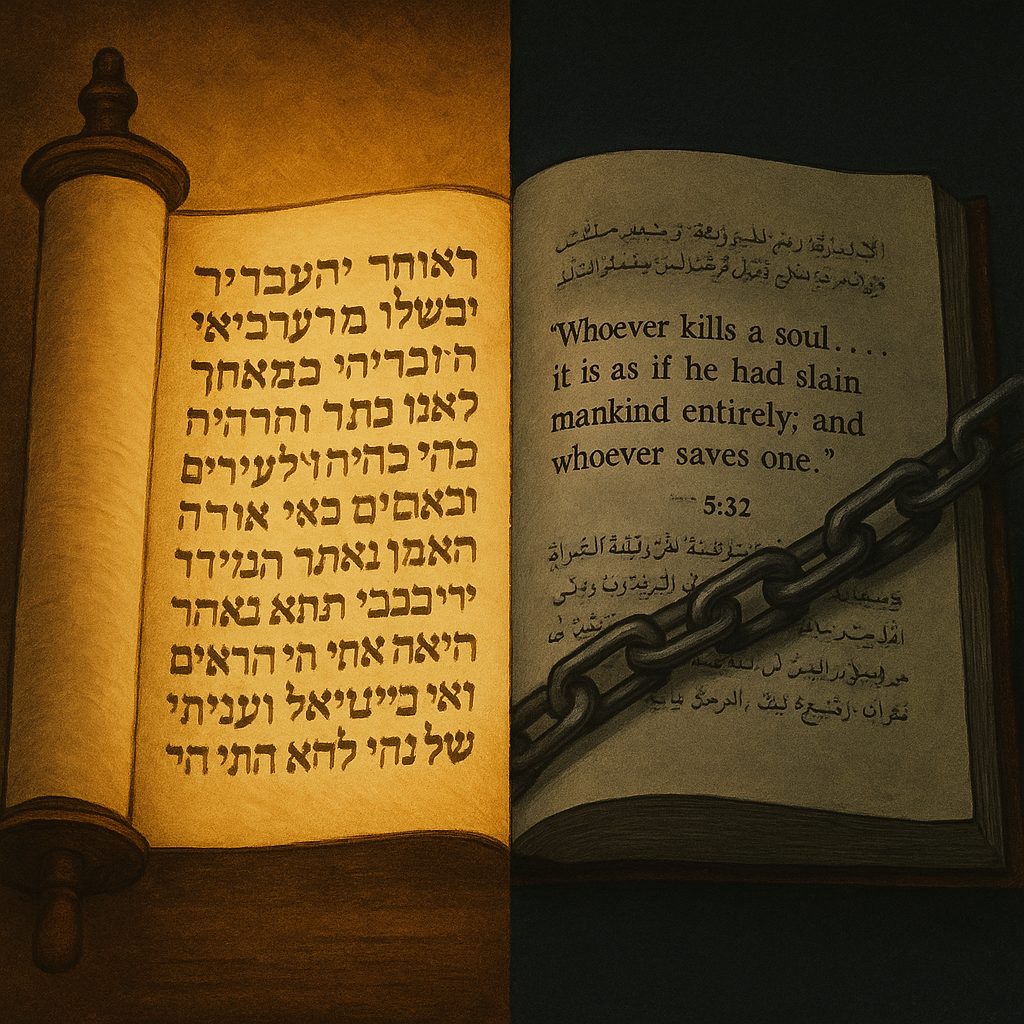
Every time someone points out Islamic violence, the apologists crawl out like clockwork, armed with the same verse they believe ends all debate:
> “Whoever kills one person, it is as if he killed all of mankind; whoever saves one person, it is as if he saved all of mankind.”
Beautiful, right? Poetic. Almost Western. The only problem?
It isn’t Islamic.
That verse didn’t come from the Qur’an’s moral imagination — it came straight out of the Talmud, the backbone of Jewish ethics and jurisprudence, centuries before Muhammad was even a rumor.
—
 The Original Line — From the Talmud, Not the Desert
The true origin is in Mishnah Sanhedrin 4:5:
> “Whoever destroys a single life, it is as if he destroyed an entire world; and whoever saves a single life, it is as if he saved an entire world.”
In Jewish understanding, this isn’t cheap poetry — it’s profound moral mathematics.
Each person represents an entire world of potential — future descendants, stories, legacies. To kill one person is to erase an infinite lineage, especially in a world where every human life mattered for survival.
The Talmudic phrasing reflects both biological reality (small populations, generational continuity) and spiritual depth — the sanctity of the image of God in each person (tzelem Elohim).
It’s a warning that every life you destroy carries within it all the lives that will never be.
So yes, “the verse about humanity” was Jewish — and deeply so.
When Islam copied it, it lost both the science and the soul.
—
 The Quranic Imitation — 5:32 and Its Missing Context
Now let’s look at the Qur’an, verse 5:32:
> “Because of that, We decreed upon the Children of Israel that whoever kills a soul—unless for murder or corruption in the land—it is as if he had slain mankind entirely; and whoever saves one, it is as if he had saved mankind entirely.”
Did you catch it? “We decreed upon the Children of Israel.”
It’s not even addressed to Muslims — it’s God recounting what He told the Jews. The verse is an open citation of their law.
In other words, Islam didn’t originate this idea — it acknowledged it, then immediately qualified it to death.
Because the very next verse, 5:33, says:
> “Indeed, the penalty for those who wage war against Allah and His Messenger and strive upon earth [to cause] corruption is that they be killed or crucified or have their hands and feet cut off on opposite sides…”
So in context, the message becomes:
“Don’t kill anyone… unless they annoy us.”
—
 Why the Original Made Sense — And the Copy Doesn’t
The Talmudic teaching rests on the idea that every human being is a vessel of creation.
Destroy one life, and you destroy a universe of potential.
That’s why the rabbis could say saving a single person “saves the world” — they were speaking from a civilization that viewed humanity as creative continuity.
Remove the Torah and the concept of divine image, and the phrase loses meaning.
It becomes a hollow slogan — a line that sounds deep until you ask, “Wait, why exactly does one life equal mankind?”
Without Jewish metaphysics, the arithmetic doesn’t add up.
The Qur’an keeps the poetic shell but discards the logic that gave it weight.
It’s like ripping a line out of Shakespeare, scribbling your name under it, and wondering why the rhythm died.
—
 Tafsir, Tweaks, and Modern PR
Even early Muslim scholars weren’t pretending this was a universal Islamic law.
Ibn Kathir, al-Tabari, and others all stated clearly that this verse referred to the Children of Israel, not to the Muslim community.
Modern Muslim preachers, however, conveniently forget that part.
They quote it on talk shows and Twitter threads as if it were a revelation to Muhammad himself.
It’s propaganda by half-quotation — a moral costume designed to make Islam look civilized to a Western audience that never reads the footnotes.
And Western journalists lap it up like cream.
> “See? Islam values life!”
Sure — right up until verse 33, where it starts listing the punishments again.
—
 What It Really Teaches (If You’re Honest)
In Judaism:
The verse teaches that human life is sacred because each person mirrors the divine, and killing one erases a whole future of lives and worlds.
In Islam:
It’s a citation of Jewish ethics turned into a conditional legal clause. Life is valuable — unless the state decides you’re “corrupt,” “apostate,” or “an enemy of Allah.”
In modern PR:
It’s a borrowed quote used to silence criticism and sell moral superiority.
They didn’t just borrow a verse — they flattened it, edited it, and weaponized it.
—
 Killing Meaning, Not Just People
When you strip an idea of its roots, you kill its soul.
The Talmud taught that one life equals a world because every life carries infinite potential.
The Qur’an borrowed the line, removed the reason, and now its followers quote it like a peace slogan at a funeral they caused.
If Islam truly believed killing one person is killing all humanity —
humanity wouldn’t be running out of people to quote it.
Leave a Reply