
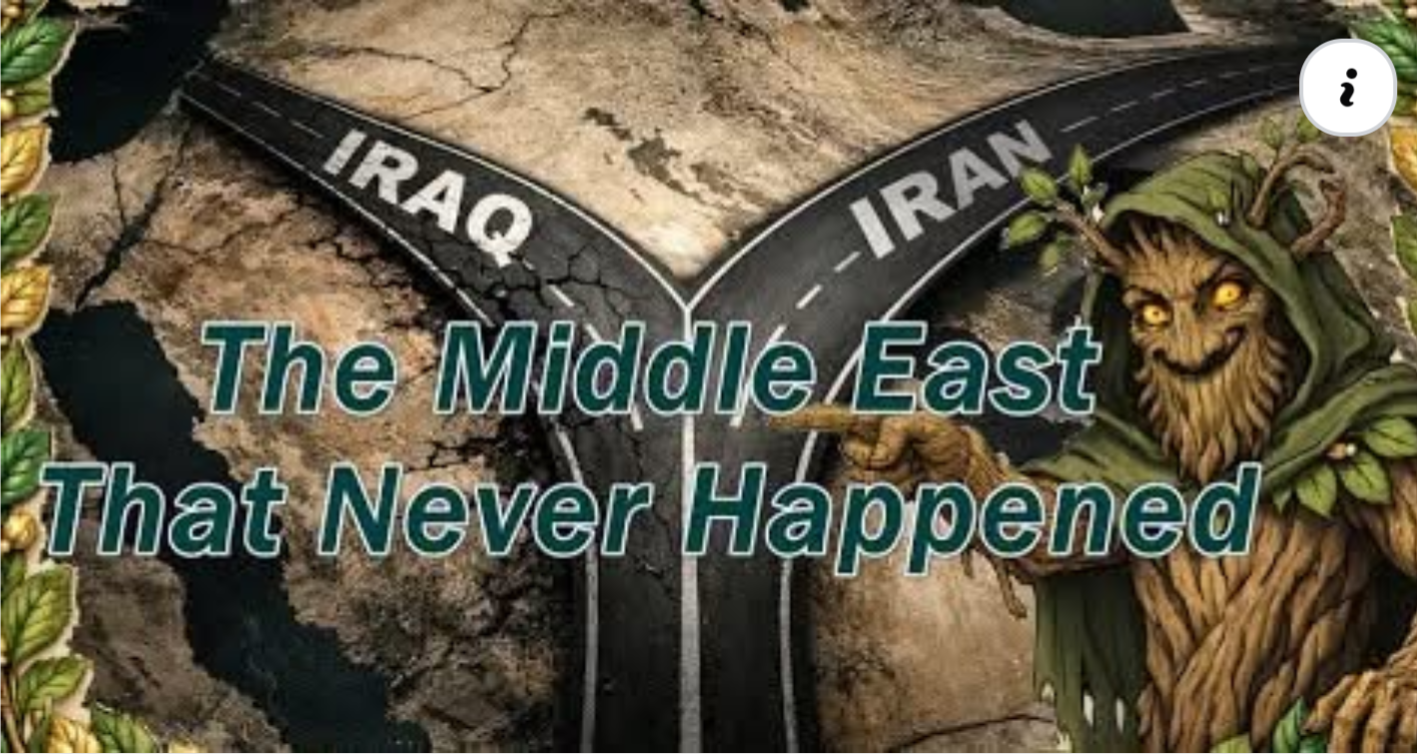
What if the United States had pursued regime change in Iran instead of invading Iraq?
Counterfactuals are dangerous when they become fantasies. But they are useful when they illuminate missed leverage and avoidable failure. This is not an argument that regime change is easy, clean, or moral by default. It is an exercise in comparative outcomes.
The question is simple:
If the United States had successfully disrupted or replaced the Iranian theocratic regime in the early 2000s—rather than invading Iraq—would the Middle East, and especially Afghanistan, look different today?
The answer is uncomfortable for many narratives: yes, very likely—and in ways that matter.
1. The Premise: Iran Instead of Iraq
In 2003, the U.S. chose to remove Iraq from the regional map as a functioning state. The justification was weapons of mass destruction and democratic dominoes. The result was state collapse, sectarian war, and eventually ISIS.
At the same time, Iran—the actual revolutionary power exporting ideology, militias, and asymmetric warfare—was left intact and, paradoxically, empowered.
A successful regime change in Iran does not mean a US occupation of Tehran. The more plausible model would have been:
sustained political and economic pressure on the IRGC,
intelligence and financial warfare,
support for internal opposition,
elite defections,
and minimal visible US military footprint.
In the early 2000s, this window existed. It no longer does.
2. The Effect on Afghanistan
The war in Afghanistan began in 2001 and was initially successful. The Taliban regime collapsed quickly. The failure came later.
Iran’s role in Afghanistan is often simplified. Pre-2001, Iran backed the Northern Alliance against the Taliban and quietly cooperated with the US. Post-2003, after being labeled part of the “Axis of Evil,” Iran shifted to a spoiler strategy—limited arms, training, and facilitation to Taliban elements, not out of ideological affinity, but to bleed American forces.
A post-theocratic Iran would almost certainly have:
cut off any Taliban assistance,
cooperated on border security,
supported a non-Taliban Kabul government.
This would not have “solved” Afghanistan. Pakistan would remain the primary spoiler. But it would have shortened the insurgency, reduced IED sophistication, and improved the odds of an earlier negotiated settlement.
Crucially, skipping Iraq would have preserved US focus. Afghanistan became the “forgotten war” precisely because Iraq consumed attention, manpower, and credibility.
3. Proxies: Hamas, Hezbollah, and the Houthis
Iran is not just a regional actor. It is a proxy factory.
Hezbollah
Hezbollah is the clearest case. It is an Iranian creation in funding, training, and doctrine. Without the IRGC:
no strategic missile arsenal,
no regional expeditionary role,
no near-state within a state.
Hezbollah might survive as a Lebanese political-military faction, but it would not be a regional deterrence power.
Hamas
Hamas is Sunni and not ideologically Iranian, but Iranian support transformed it from a local insurgency into a regional actor. Without Iranian weapons, cash, and training:
Hamas remains violent,
but poorer, more isolated,
and less capable of large-scale escalation.
The conflict does not disappear. Its scale and lethality shrink.
Houthis
The Houthis are almost entirely a product of Iranian strategic expansion after 2011. Without Iran:
no long-range missiles,
no drone warfare,
no Red Sea disruption.
In this scenario, the Houthis likely remain a local Yemeni actor, not a global shipping threat.
4. The Assad Regime
The survival of Bashar al-Assad is one of the clearest indicators of Iranian power.
Assad survived because of:
Iranian money and logistics
Hezbollah ground forces
Later, Russian airpower
Remove Iran from the equation before the Arab Spring, and the Syrian regime is dramatically weaker. When unrest begins, Assad faces:
faster elite defection,
less militia support,
reduced ability to endure sanctions and isolation.
In this scenario, Assad likely falls early or is forced into a negotiated transition. The prolonged Syrian civil war as we know it is unlikely to occur.
5. The Broader MENA Picture
In this counterfactual:
There is no consolidated “Shia Crescent.”
Proxy warfare is fragmented and underfunded.
Regional conflicts remain local instead of synchronized.
Afghanistan is less isolated and less protracted.
ISIS never emerges as a territorial state.
This does not produce a peaceful Middle East. But it produces a less militarized, less ideologically unified, and less globally disruptive one.
The irony is sharp: by destroying Iraq, the US removed Iran’s main regional counterweight and handed Tehran strategic depth on a silver platter.
Conclusion
This is not an argument that Iran would have become a liberal democracy overnight. It is an argument about relative damage.
Invading Iraq:
created ISIS,
empowered Iran,
strengthened proxies,
prolonged Afghanistan,
and destabilized the region for a generation.
A successful disruption of the Iranian theocracy in the early 2000s would likely have:
weakened proxy networks,
shortened the Afghan war,
prevented the Syrian catastrophe,
and reduced the scale of regional conflict.
History does not give do-overs. But it does allow us to identify the wrong fork in the road.
Iraq was the wrong target.
Iran was the keystone.
Leave a Reply