
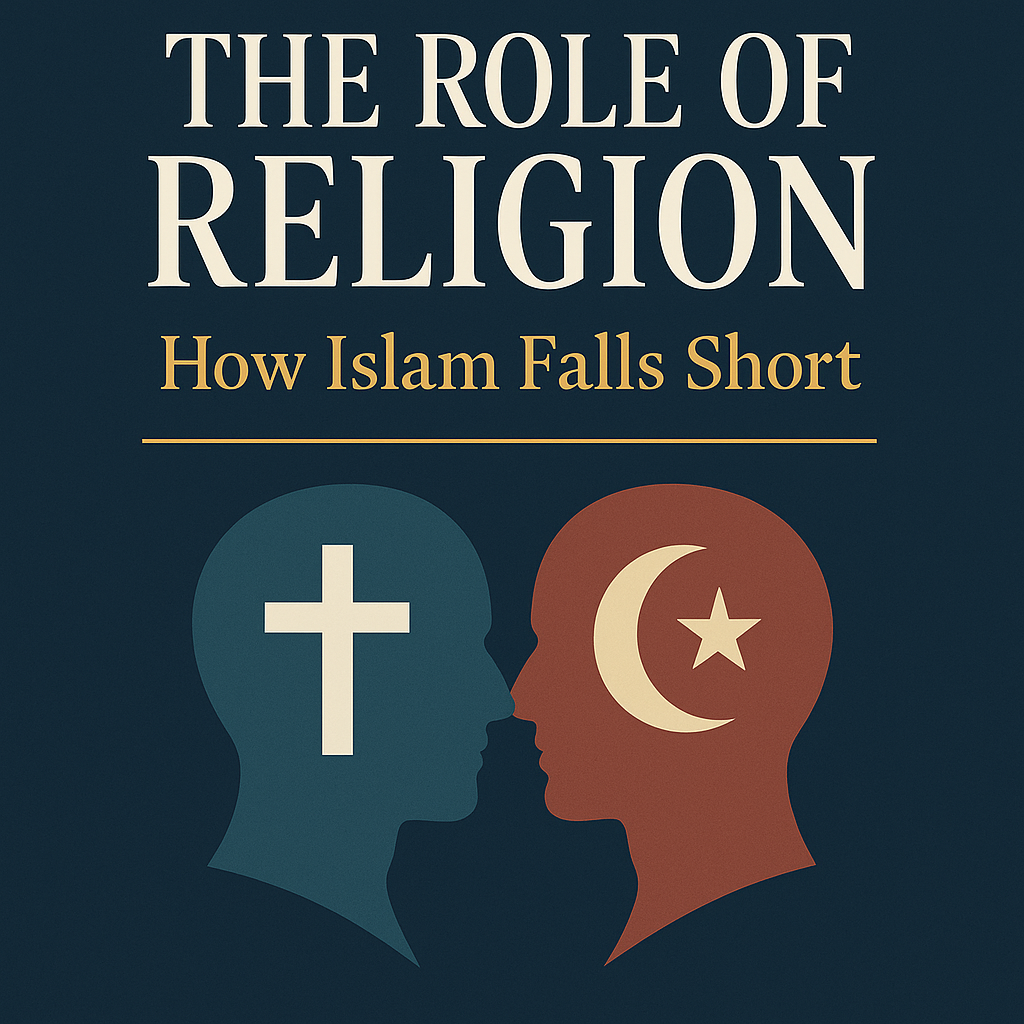
I. Introduction: Religion as a Survival Technology
For most of human history, religion wasn’t optional — it was existential. Tribes without binding rituals, shared moral codes, or supernatural threats to keep the psychopathic in check didn’t last long. The gods weren’t just metaphysical mascots. They were evolutionary hacks — tools our ancestors used to coordinate behavior, enforce cooperation, and build trust in the absence of centralized authority.
In that sense, religion is less about metaphysical truth and more about functional utility. You don’t need your god to be real; you just need your people to believe he’s watching. Societies that developed effective religious frameworks outcompeted those that didn’t. And over time, the most cohesive, cooperative, and child-rearing-optimized groups expanded. The faiths that helped produce those outcomes were the ones that stuck.
This is the argument advanced by people like Jonathan Haidt, David Sloan Wilson, and Joseph Henrich: religion, in its best form, acts as an evolutionary stabilizer — a “social glue.” It promotes long-term planning, curbs violent instincts, regulates sexual behavior, and enforces moral codes, even on people who don’t have any intrinsic reason to care.
But not all religions are created equal.
Some emerged not to build stable societies, but to expand empires. Some don’t emphasize personal moral development, but enforce conformity through law and violence. And some — like Islam — may have worked brilliantly as tools for conquest, but collapse into dysfunction once the dust of war settles.
That’s what this article will explore:
How religion functions in the survival of civilization — and how Islam, by failing these core tests, reveals itself not as a force for long-term flourishing, but as a relic of tribal domination.
II. Monogamy as Social Infrastructure
Monogamy isn’t just a moral ideal — it’s a social engineering solution.
Civilizations that enforced pair-bonding between men and women, restricted male sexual access to a single partner, and promoted father involvement in child-rearing saw greater stability, lower violence, and higher long-term investment in offspring. This isn’t just romanticism — it’s anthropology, backed by data.
As Joseph Henrich points out in The “WEIRDest People in the World”, enforced monogamy radically reduces what’s known as male-male competition. If a small elite of men monopolize women — as happens in highly polygynous societies — you create a large, angry underclass of single men with no stake in society. What follows is predictable: tribal violence, warfare, and the breakdown of social cohesion.
In contrast, monogamous systems force men to compete by becoming reliable, productive partners and fathers. That turns their energy toward economic contribution, not sexual conquest. The result? Societies where more men are invested in the future — not burning it down.
This is precisely where Islam fails.
While Islam doesn’t technically require polygamy, it permits up to four wives for men (and zero for women, obviously). In practice, this leads to unequal marriage markets — especially in tribal societies — where powerful men collect wives, and less powerful men are shut out. Combine that with cousin marriage (which concentrates power within family lines) and you get a recipe not for social harmony, but for resentment, violence, and clannishness.
There’s a reason radical jihadist movements are filled with sexually frustrated young men. A society that doesn’t offer them a path to stability — only a promise of 72 virgins in the afterlife — isn’t solving the mating crisis. It’s weaponizing it.
III. Family and Kinship Stability
Strong families are the engine of civilization.
They provide structure for children, responsibility for adults, and a multigenerational feedback loop of cultural transmission. When families work, societies don’t need surveillance states. Morality, discipline, and values are passed from parent to child, reinforced by shame and honor, not social workers and police.
A successful religion doesn’t just preach morality — it encodes it into the rhythms of family life. It promotes stable marriages, paternal responsibility, and the sacredness of the child.
Islamic tradition, however, does not deliver on these fronts.
On paper, Islam looks family-friendly: it encourages marriage, warns against fornication, and calls children a blessing. But in practice, the structural incentives break down — especially when you examine the legal leniency toward abuse, and the cultural normalization of violence inside the home.
1. Domestic Violence:
In many Islamic countries, domestic violence is either legal, lightly punished, or culturally accepted.
According to a 2013 UN Women study, over 87% of Egyptian women reported being victims of domestic violence.
A 2021 Pew survey found that a significant proportion of Muslims in regions like South Asia and the Middle East believe a husband is justified in hitting his wife “under certain conditions.”
In countries like Afghanistan, Pakistan, Somalia, and Iran, laws either fail to explicitly criminalize domestic violence or enforce it weakly. In some cases (like the infamous Surah 4:34), violence is even scripturally permitted under the guise of “discipline.”
2. Child Abuse:
The concept of children’s rights — especially freedom from corporal punishment and forced labor — is poorly protected in many Islamic societies.
In Pakistan, Yemen, and parts of Saudi Arabia, child labor is endemic, often enforced within families.
UNICEF reports routinely cite child marriage, female genital mutilation, and severe corporal punishment as ongoing issues — frequently defended by religious or cultural justifications.
3. Legal Infrastructure:
In many Muslim-majority nations, family law is governed by Sharia courts, where:
A woman’s testimony is worth half that of a man’s.
Mothers often lose custody to the father’s family after divorce.
Abuse allegations must pass extremely high burdens of proof, and victims are often shamed.
This isn’t the framework of a healthy family system — it’s a patriarchal tribal enforcement mechanism. It prioritizes male control over child welfare, and clan loyalty over emotional health.
In contrast, moral frameworks shaped by Judeo-Christian influence (and Enlightenment ideals) have, over time, evolved to protect women and children legally — not just spiritually. Marital rape is criminalized. Corporal punishment is regulated or banned. Welfare systems exist to help abused spouses escape. Are they perfect? No. But they represent a trajectory away from brutality — not toward it.
Islam, by contrast, locks its legal system in the 7th century and calls it divine. There is no incentive to evolve, only to obey.
IV. External Morality and the Psychopath Problem
Most people are not saints.
Most people are not monsters.
But every society must account for both.
The moral core of a functioning civilization isn’t just about inspiring goodness — it’s about containing those who are incapable of it. In any population, there’s a percentage of individuals who lack empathy, pursue power or pleasure without guilt, or are easily swayed by dominance hierarchies. In clinical terms: narcissists, sociopaths, psychopaths — and everything in between.
Religions that survive long-term don’t just guide the kind-hearted. They instruct the average, and restrain the dangerous. They do this by wrapping morality in divine command, embedding it in community shame, and reinforcing it with ritual repetition.
If you’re a psychopath, the only thing that might stop you from lying, stealing, abusing, or killing is the belief that an all-seeing God will catch you — and everyone around you will punish you for stepping out of line.
This is where Islam fails catastrophically.
Instead of restraining the worst instincts of man, Islam channels them into divine license. Violence, deceit, and domination aren’t just permitted — they’re sacred when done in service to Allah.
Lying (taqiyya) is allowed to protect the faith.
Slavery, rape, and child marriage were practiced by Muhammad himself.
Killing apostates isn’t just allowed — it’s celebrated.
Women are “fields to be plowed”, disobedient wives can be beaten, and non-believers are considered less than human in many classical texts.
What kind of message does this send to the psychopath?
It says: your darkest impulses are not sins — they’re duties.
Where Christianity put a leash on the strong to protect the weak, Islam hands the leash to the strong and tells them they were born to lead. And while modern Christianity has spent centuries reforming, apologizing, and adapting to human rights norms — Islam codifies dominance as divine, and reforms are branded heresy.
This is why Islamist movements attract not just the devout, but the cruel, the unhinged, and the power-hungry. It is not a bug. It is the system working as designed.
V. Evolutionary Success vs. Long-Term Collapse
Not all survival strategies are built to last.
In evolutionary terms, Islam was wildly “successful” in its early centuries. It exploded out of Arabia through war, tribute, and tribal loyalty, absorbing vast territories in record time. It spread fast, demanded total conformity, and rewarded aggression and expansion. In a brutal and chaotic world, this made it a formidable survival engine.
But there’s a catch.
Strategies that maximize short-term gains through conquest often self-destruct in the long run. Empires built on force rot from within when the momentum slows. Once expansion ends, the internal contradictions surface: economic stagnation, intellectual suppression, social decay.
The Suppression of Intellectuals
A critical factor in this decline was the systematic suppression of intellectuals and free thought. While the Islamic Golden Age is often celebrated, it was punctuated by episodes where scholars and thinkers were persecuted:
Ibn al-Khatib, a polymath and vizier in Granada, was executed in 1374 for alleged heresy. His body was burned posthumously, reflecting the intolerance towards philosophical inquiry that deviated from orthodox views.
Yahya al-Suhrawardi, a prominent Sufi philosopher, was executed in 1191 under the orders of Saladin for his philosophical teachings, which were deemed heretical.
In Persia, during the Umayyad conquest, reports indicate that Arab armies killed those who could read and write the Khwarezmian language, leading to the loss of significant cultural and intellectual heritage.
The execution of Nadr ibn al-Harith, an Arab physician and critic of Muhammad, exemplifies the early suppression of dissenting voices. He was executed after the Battle of Badr for his opposition to Islamic teachings.
These actions contributed to a culture where intellectual conformity was enforced, and deviation was met with severe punishment.
Long-Term Consequences
Compare this with Judaism and Christianity, which evolved to prioritize community structure, moral reflection, education, and non-violent resilience. Their growth wasn’t explosive, but sustainable. Their success wasn’t built on war, but on adaptation and cultural transmission.
Islam, by contrast, struggles to reform because its theology sacralizes dominance. Unlike Christianity — which separates church from state, accepts reinterpretation, and accepts being out of power — Islam never left the battlefield. It binds faith, law, and governance into a single, inflexible block. That rigidity slows innovation, encourages authoritarianism, and eventually leads to civilizational stagnation.
We can see this in the modern Islamic world:
Economic underdevelopment despite resource wealth
High rates of cousin marriage and resultant genetic issues
Education systems that often prioritize memorization over inquiry
Authoritarian regimes justified by religious law
Low innovation output compared to global standards
Islam’s early success created a structural trap: it cannot easily evolve without negating its founding logic. And that logic — conquest, obedience, and tribal supremacy — is a poor fit for modern, pluralistic societies.
In the end, religions that stabilize and restrain flourish.
Religions that conquer and consume eventually collapse.
Conclusion: Conquest Is Not Civilization
Religion, at its best, acts like scaffolding for civilization — guiding instinct with structure, moralizing impulse, and suppressing behaviors that would otherwise destroy long-term group survival. It teaches restraint to the aggressive, loyalty to the wayward, and imposes consequences on those who feel none internally. Traditions that enforced monogamy, honored the family unit, and built moral codes into law and story helped humanity survive and flourish. Even atheists benefit from those systems’ downstream effects.
But Islam, as both doctrine and historical practice, fails at nearly every turn of that evolutionary test.
Rather than evolving as a stabilizing tradition, it thrived as a military and cultural battering ram — expanding rapidly, then stagnating under its own inflexible rules. The early Islamic caliphates did not absorb or elevate the intellectual elites of conquered lands — they often executed them. The case of Nadr ibn al-Harith, beheaded for reciting superior Persian fables, is an omen of what was to come: rigid censorship disguised as revelation.
Centuries later, in the romanticized “Golden Age” of Andalusia, we’re told Islam fostered a haven of learning and tolerance. But even that story, upon inspection, collapses. Critical scholarship — such as that of Dario Fernández-Morera — shows that non-Muslims lived under heavy oppression, and that intellectual freedom was always contingent on deference to Islamic dogma.
Islam proved itself as a tool of conquest, not a blueprint for civilizational longevity. It could take — but not build. Its structure prioritizes obedience over curiosity, submission over conscience, and expansion over sustainability.
As Jonathan Haidt’s moral foundations theory explains, successful moral systems balance five (later six) intuitive pillars: care, fairness, loyalty, authority, sanctity, and liberty. Western religions — especially in their evolved, post-Enlightenment forms — strike some equilibrium between them, making room for dissent, reform, and innovation. Islam, by contrast, overweights authority and sanctity to the exclusion of liberty and fairness. It does not tolerate internal contradiction, nor can it accommodate pluralism without dissolving its core.
It remains, in its unreformed state, a Bronze Age operating system running on modern hardware — and inevitably crashing civilization whenever it regains administrator access.
Leave a Reply